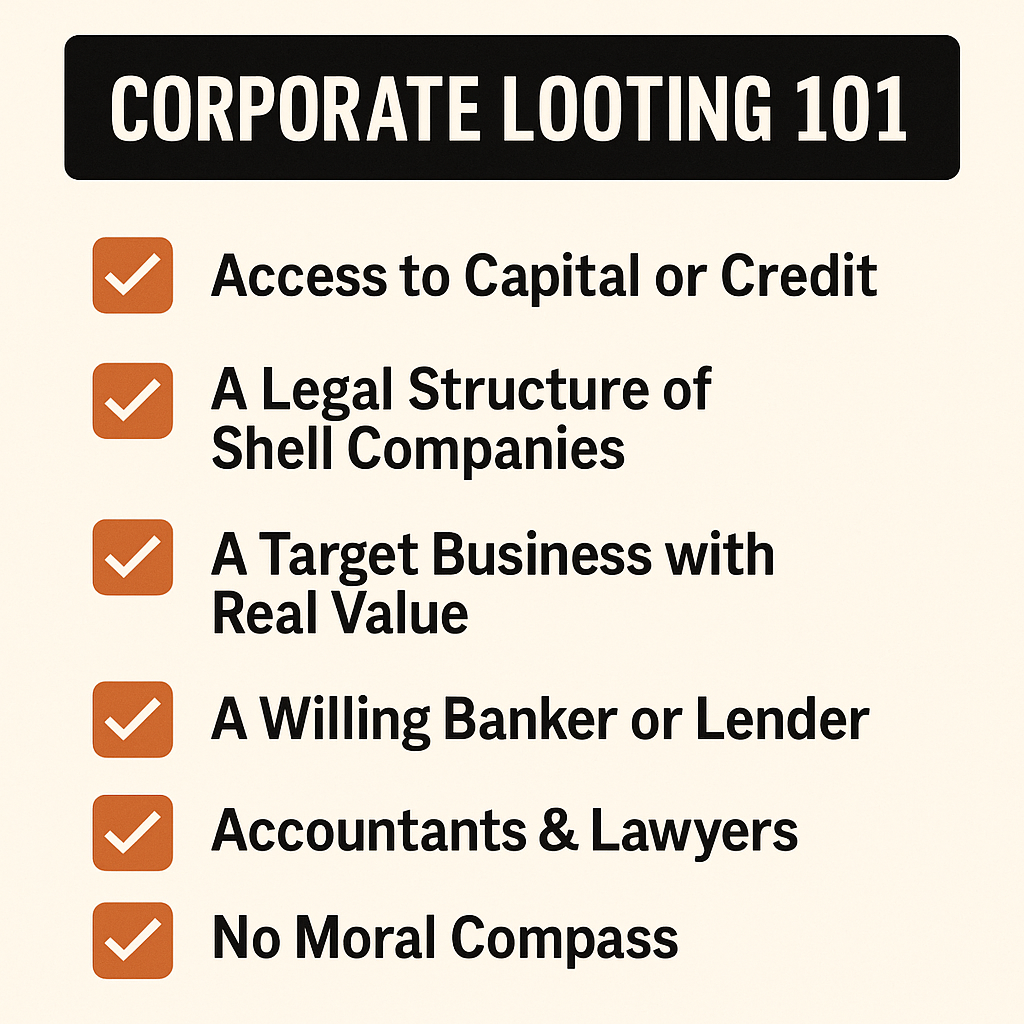
(A step-by-step guide to legal looting, for the morally bankrupt.)
“Private equity” is just financial arson dressed in a suit.
It creates nothing, but sucks value from productive businesses, leaving a hollowed-out husk for communities and taxpayers to sweep up. Shell companies are the getaway cars. The real business isn’t turnaround — it’s burn-and-run.
They don’t build. They bleed. They don’t rescue. They ransack.
And they always get paid — whether the company lives, dies, or burns to the ground.
And the money? It comes from your rent, your job, your pension, and your taxes.
👣 STEP 1: Start With Nothing
You make a shell company. Just a name, a suit, and a lawyer with a heatproof conscience.
Shell companies are legal tools with no active business operations — useful for hiding liability or ownership.
- Private equity firms use these to avoid risk and distance themselves legally from disaster.
- Example: The structure used in the Toys “R” Us buyout concealed who held the debt until collapse.
🏦 STEP 2: Borrow Money You’ll Never Pay Back
You borrow millions to buy a real company – using that company’s own future profits as the guarantee. Seriously.
This is a Leveraged Buyout (LBO): buying a company using debt secured by the company itself.
- Common practice in private equity.
- In 2005, KKR and Bain Capital loaded Toys “R” Us with $5B in debt — resulting in its 2017 bankruptcy.
- Harvard Business Review: “Private Equity: Overvalued and Overrated”
🪓 STEP 3: Rip It Apart
Sell the buildings. Sell the equipment. Sell the logo if it’s shiny enough. Then rent it all back to the company you just gutted.
Asset stripping = selling off a company’s assets and pocketing the value.
- In 2014, Red Lobster was sold by Darden Restaurants to Golden Gate Capital. GGC then sold Red Lobster’s real estate to a REIT they owned and began charging rent.
- Bloomberg: “How Red Lobster Became a Victim of Private Equity”
🧾 STEP 4: Invoice the Corpse
Now charge it made-up bills: “Consulting”, “Strategy Alignment”, “Visioneering” – all fake, all profitable.
Management and consulting fees are often added to PE-owned companies to extract ongoing income.
- These charges are baked into the operating agreements, draining cash even in distress.
- Private Equity Stakeholder Project Report, 2021
📊 STEP 5: Cook the Books to Look Like a Chef
Fire half the staff. Close branches. Slash costs. Boom – looks like profit. On paper, you’re a genius. In reality, you’re a butcher.
Slash and sell to make profit numbers look good.
- Artificial short-term profit boosts include: asset sales, service reductions, and mass layoffs.
- Makes companies look profitable to lenders or Wall Street — until they’re not.
💸 STEP 6: Borrow Again (Yes, Really)
Use the fake profits to get another loan. Then pay yourself a big, juicy special dividend. From borrowed money.
Special dividends allow PE firms to extract cash directly from portfolio companies — funded by debt.
- Dividends can only be paid from profit, but PE engineers short-term surpluses to justify them.
- The American Prospect: “How Private Equity Extracts Wealth”
🧟 STEP 7: Let It Die
When the debt crushes the business, file for bankruptcy. Shrug. Walk away. Keep the assets. Let the government and workers clean up the mess.
Bankruptcy is the final move. Debt stays. Assets are already long gone.
- The wreckage — unpaid wages, ruined pensions, shuttered stores — becomes a public problem.
- NYT: “How Private Equity Is Killing Everything You Love”
🧨 Who Pays the Price?
👨👩👧 Consumers & Communities
- Prices increase, services degrade, jobs vanish.
- Critical industries like healthcare, food service, and housing are often targeted.
- Entire towns lose anchor businesses.
👩💼 Workers & Employees
- Mass layoffs, loss of pensions, frozen wages.
- Severance denied due to “bankruptcy.”
🧓 Pension Funds & Savers
- Bundled junk loans often end up in pensions or retirement accounts.
- When defaults spike, retirement savings collapse.
🏛️ Governments (and taxpayers)
- When vital services fail, governments step in.
- E.g., hospital bailouts, unemployment benefits, community redevelopment grants.
- Public funds clean up private greed.
🧠 Extrapolated Tricks Not Explicitly Mentioned (but widely used)
- Tax arbitrage: Losses from the bankrupt company offset gains elsewhere.
- Lobbying for lax regulation: Ensures the cycle can repeat.
- Install insider executives: Often complicit or incentivized via golden parachutes.
- Delay vendor payments to hoard cash: Vendors collapse or are forced to renegotiate under threat.